Strangers Next Door: The Collapse of American Neighborhood Life and the Difficult Work of Rebuilding It
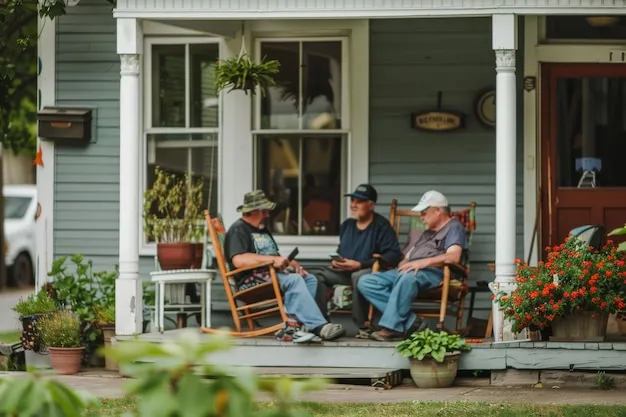
Photo: diverse neighbors talking on front porch of American home, via img.freepik.com
The Distance Between Doors
There is a particular kind of loneliness that arrives not in empty rooms but on crowded streets. It is the loneliness of the person who has lived in the same apartment building for six years and does not know the name of the neighbor directly across the hall. It is the loneliness of the suburb where garage doors open and close like curtains, where children play in backyards invisible to one another, where an entire block can grieve a loss in private because no one knew there was anything to grieve.
This is not a marginal experience. According to data from the Survey Center on American Life, more than half of Americans report having few or no close friends in their immediate neighborhood. The United States Surgeon General's 2023 advisory on the epidemic of loneliness identified social disconnection as a public health crisis comparable in its consequences to smoking fifteen cigarettes a day. And yet the conversation about rebuilding community often remains abstract—a nostalgic appeal to a golden age of front porches and block parties that, for many communities, never quite existed in the first place.
The real question is not whether Americans used to know their neighbors better. The real question is what structural and cultural forces have made proximity without relationship the dominant experience of modern American life—and what it actually takes to reverse it.
How We Got Here
The erosion of neighborhood bonds did not happen overnight, and it did not happen by accident. Several decades of deliberate policy choices—suburban zoning that eliminated mixed-use, walkable space; highway construction that severed urban neighborhoods from one another; the decline of third places like libraries, civic clubs, and neighborhood churches—created physical environments that are architecturally hostile to spontaneous human connection.
At the same time, the economy reshaped the rhythms of daily life in ways that left little room for the slow, unhurried time that neighborly relationship requires. When both adults in a household work multiple jobs, when commutes consume two hours of each day, when children's schedules are managed by apps and shuttled between structured activities, the unplanned encounter—the conversation over a fence, the borrowed cup of sugar, the impromptu gathering on a stoop—becomes a casualty of efficiency.
Digital technology compounded the problem in ways that were not initially obvious. Social media promised to expand connection, and in some respects it did. But it also gave people permission to curate their social lives with unprecedented precision, selecting relationships that affirm rather than challenge, communities of interest rather than communities of place. The neighbor who holds different political views, listens to different music, or keeps different hours is harder to mute than a social media account—and so, increasingly, people simply opt out of the relationship altogether.
The Cost of Disconnection
The consequences of this fragmentation extend well beyond personal unhappiness. Neighborhoods that lack social cohesion are demonstrably less resilient in the face of crisis. Research consistently shows that communities with strong informal networks—where neighbors know and trust one another—recover faster from natural disasters, experience lower rates of crime, and maintain higher levels of civic participation. The social fabric, it turns out, is not decorative. It is load-bearing.
From a peacebuilding perspective, the implications are particularly significant. Conflict resolution depends on a baseline of relationship. When neighbors are strangers, minor disputes—a barking dog, a property line disagreement, a noise complaint—escalate quickly into adversarial confrontations precisely because there is no reservoir of goodwill to draw upon. The absence of relationship does not produce neutrality. It produces suspicion.
In communities fractured along lines of race, class, or immigration status, that suspicion can harden into something far more damaging. The neighbor who remains a stranger is far easier to fear, to resent, or to scapegoat than the neighbor whose name you know, whose children you have watched grow, whose struggles you have glimpsed through an open window on a difficult evening.
What Actually Works
The good news—and it is genuinely good news—is that communities across the country are demonstrating that reconnection is possible, and that it does not require extraordinary resources or heroic effort. What it requires is intentionality, patience, and the willingness to design for encounter rather than efficiency.
Community gardens have emerged as one of the most reliably effective tools for rebuilding neighborhood bonds, not because gardening is inherently social, but because shared stewardship of a common resource creates repeated, low-stakes reasons for people to show up in the same place over time. The relationship that begins with a question about tomato blight can, over seasons, become something durable and mutual.
Block associations and neighborhood councils, when designed inclusively, serve a similar function. The key word is inclusively. Associations that reflect only the interests and demographics of long-term residents can entrench existing hierarchies rather than bridge them. The most effective neighborhood organizations actively recruit across lines of difference, conduct outreach in multiple languages, and structure their meetings to ensure that every voice carries weight—not merely the voices of those who arrived first or own rather than rent.
Informal social infrastructure matters enormously, and it is often the first thing to disappear when budgets are cut. Free neighborhood libraries, public benches positioned to encourage conversation rather than discourage loitering, community bulletin boards, open green space without fees or permits—these small investments signal that a neighborhood is a place where lingering is welcome, where people are expected to encounter one another as a matter of ordinary life.
Some cities are experimenting with more deliberate interventions. Programs modeled on the "Hello Neighbor" initiative pair recently arrived residents—including refugees and immigrants—with established community members for structured relationship-building. Others have adapted the tools of restorative practice, bringing neighbors together in facilitated circles not to resolve specific disputes but to build the relational foundation that makes future disputes easier to navigate.
Proximity Is Not Enough
It would be a mistake, however, to romanticize neighborhood connection without acknowledging its complexity. Proximity alone does not produce peace. In communities with histories of displacement, redlining, or racial violence, the call to simply "get to know your neighbors" can feel tone-deaf or even threatening, particularly when gentrification is actively reshuffling who belongs in a neighborhood and who does not.
Authentic community peacebuilding in these contexts requires something more than shared gardens and block parties. It requires honest reckoning with the power dynamics that shape who feels welcome in a given space, whose culture is centered, and whose presence is treated as an intrusion. It requires humility from those with greater privilege and genuine accountability from institutions—municipal governments, developers, landlords—whose decisions shape the conditions of neighborhood life in ways no amount of grassroots organizing can fully counteract.
The work of rebuilding local community is, at its core, the work of peacebuilding writ small: patient, relational, structurally aware, and resistant to easy shortcuts. It begins with the recognition that the stranger across the hall is not an obstacle to a peaceful life but, potentially, one of its most essential architects.
The door is right there. The question is whether we are willing to knock.