Pass the Salt, Not the Blame: How Dinner Diplomacy Is Quietly Mending America's Fractured Politics
A Table Set for Strangers
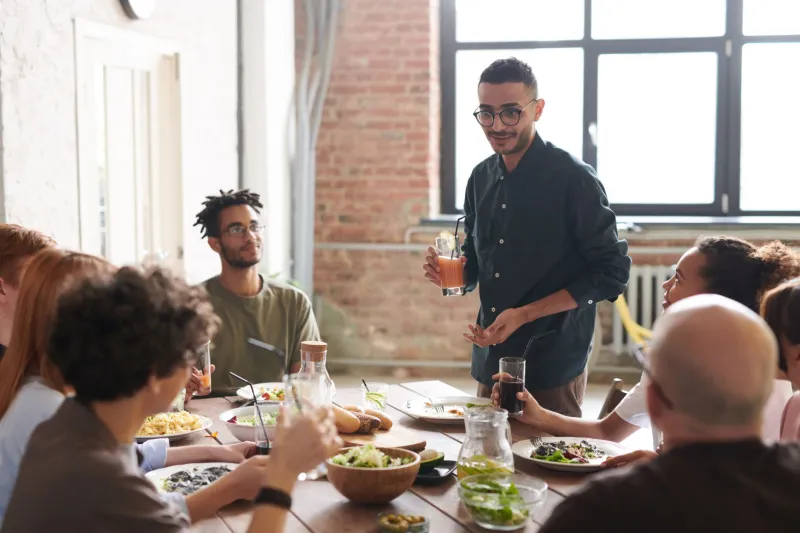
Something unusual happened on a Tuesday evening last autumn in a modest community center in Dayton, Ohio. Fourteen people — a retired steelworker who had voted Republican in every presidential election since 1984, a Black schoolteacher active in her local Democratic Party, a young evangelical pastor, a labor union organizer, a suburban mom who described herself as 'somewhere in the middle and exhausted by all of it' — sat down together and ate chicken casserole. They had never met. They had been deliberately matched by a local nonprofit specifically because their political and cultural backgrounds diverged sharply. By the time the dishes were cleared, several of them were exchanging phone numbers.
This is not an isolated anecdote. It is, increasingly, a pattern — one that a loosely connected national network of peacebuilders, community organizers, and civic entrepreneurs is working hard to replicate, refine, and expand. The movement goes by several names: 'dinner diplomacy,' 'bridge-building meals,' 'cross-partisan suppers.' The core logic is elegantly simple: seat Americans who would never otherwise choose to share space, serve them food, give them structured but gentle conversation prompts, and let the ancient human ritual of communal eating do what centuries of tradition suggest it can.
Why Food Works Where Argument Fails
The instinct to break bread as a gesture of trust is not sentiment — it is biology. Researchers at Cornell University have demonstrated that people who eat the same food during a negotiation reach agreements faster and cooperate more generously than those who do not. The act of sharing a meal triggers what social psychologists call 'synchronous behavior,' a subtle alignment of physical rhythm that nudges strangers toward a sense of shared identity rather than adversarial separation.
Beyond the neurochemistry, food carries cultural weight that few other rituals can match. To eat someone's cooking — or to eat alongside them from the same serving dish — is, in nearly every human culture, an act of provisional trust. It signals a willingness to be, if only for an hour, on the same side of something. That small shift in posture, researchers suggest, is precisely the opening that skilled facilitators need to move a conversation from defensive positioning to genuine curiosity.
Dr. Tania Israel, a psychologist at the University of California, Santa Barbara, and the author of Beyond Your Bubble, has argued that the fundamental barrier to cross-partisan understanding is not disagreement itself but the near-total absence of meaningful contact across political lines in contemporary American life. Most Americans, she notes, are now so thoroughly sorted — by neighborhood, by media diet, by social network — that they have no realistic opportunity to encounter someone of opposing political conviction as a full human being rather than as a caricature. A structured shared meal, however modest, directly interrupts that sorting.
The Organizers Building the Movement
The organizations driving this work are strikingly diverse in their origins and methods. Braver Angels, founded in the aftermath of the 2016 election, has facilitated hundreds of 'red-blue workshops' across the country, many of which incorporate shared meals as a deliberate component of their design. The organization now operates in all fifty states and has trained thousands of volunteer facilitators.
In Louisville, Kentucky, a nonprofit called The People's Kitchen has spent three years hosting monthly 'civic suppers' that pair residents from the city's predominantly white, conservative eastern suburbs with residents from its predominantly Black, progressive west end. Organizer Denise Watkins, who founded the project after years working in community mediation, describes the meal format as 'the great equalizer.' 'When you're passing someone the bread basket,' she says, 'you're not their political opponent. You're just a neighbor.'
In rural Montana, a rancher named Cal Bremer began hosting what he calls 'fence-line dinners' — outdoor cookouts on the boundary of his property where he invites both longtime ranching families and newer residents who have moved to the area from urban centers, often bringing with them very different ideas about land use, environmental policy, and the character of rural life. What began as an informal experiment has become a quarterly fixture, drawing participants from three counties.
These efforts are not uniform in their structure. Some rely heavily on trained facilitators who guide conversation through a carefully sequenced protocol. Others are deliberately loose, trusting the meal itself to create enough ease for authentic exchange. What they share is a commitment to the principle that contact precedes understanding, and that understanding must precede any durable form of civic repair.
The Honest Challenges
No serious advocate for dinner diplomacy claims it is sufficient on its own. The critics raise legitimate concerns. A pleasant evening across the political divide does not dismantle structural inequality, reverse the economic conditions that generate resentment, or alter the incentive structures of a media ecosystem built on outrage. There is also the question of who participates: the Americans most likely to volunteer for a cross-partisan supper are, almost by definition, those already inclined toward dialogue — a self-selection problem that limits the movement's reach into the communities most entrenched in mutual contempt.
There is, too, the risk of what scholars call 'false equivalence' — the suggestion that all political disagreements are simply matters of perspective to be harmonized over a good meal, when some disputes involve genuine questions of rights, dignity, and justice that cannot be resolved by goodwill alone. Facilitators working in this space are increasingly attentive to this tension, designing conversations that acknowledge structural inequities rather than papering over them with conviviality.
Scaling a Human Ritual
Despite these challenges, the question of scale is being taken seriously. Essential Partners, a Boston-based organization with decades of experience in dialogue facilitation, has begun developing a publicly available curriculum for community groups wishing to host structured bridge-building meals. Several municipal governments, including those in Tucson, Arizona, and Evanston, Illinois, have begun quietly funding local dinner diplomacy initiatives as part of broader civic health strategies.
The vision articulated by many in this movement is not a single national program but a distributed, community-rooted practice — thousands of tables, hosted by ordinary Americans, sustained not by institutional infrastructure but by the simple recognition that eating together is something human beings already know how to do. The sophistication lies in creating the conditions that make those meals genuinely transformative rather than merely polite.
A Modest and Necessary Bet
America's political divisions are not a problem that any single intervention will solve. The forces that have sorted this country into warring camps — economic anxiety, demographic change, decades of deliberate political polarization — are structural and deep. Dinner diplomacy does not pretend otherwise.
What it does claim is something more modest and, in its modesty, more credible: that human beings who have sat across a table from one another, shared food, and heard something true about each other's lives are measurably less likely to regard one another as enemies. In a political moment defined by the weaponization of contempt, that is not a small thing. It may, in fact, be exactly where the longer work of peacebuilding has to begin — not in legislatures or on cable television, but in the unglamorous, irreplaceable space of a shared meal between strangers willing, for one evening, to pass the salt instead of the blame.